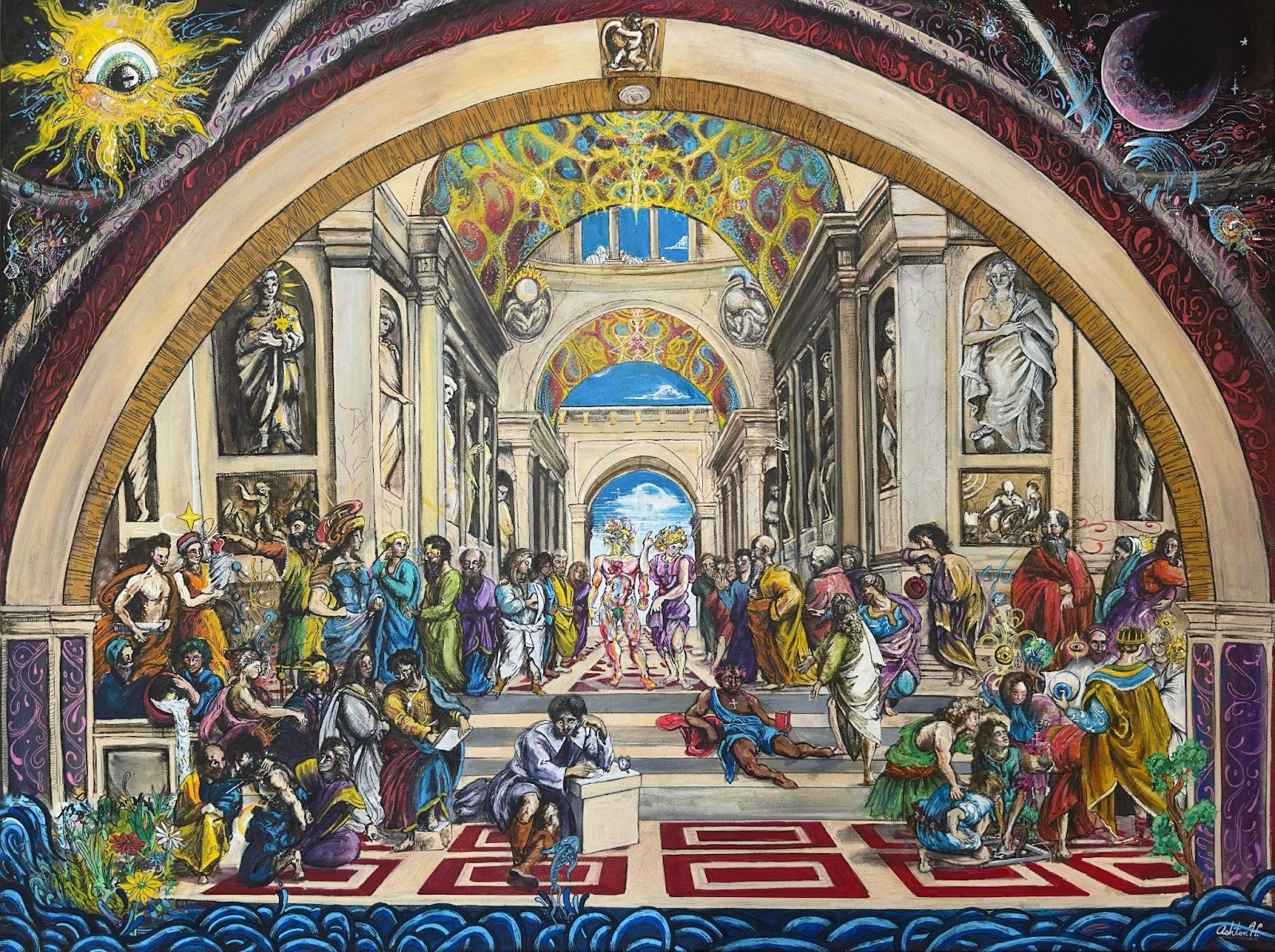
“School of Modern Man” is a mixed-media painting I produced during the frigid month of January. My goal here is to relay the thought process and the discoveries made while attempting a modern Renaissance revival over the course of 150+ hours in relative isolation.
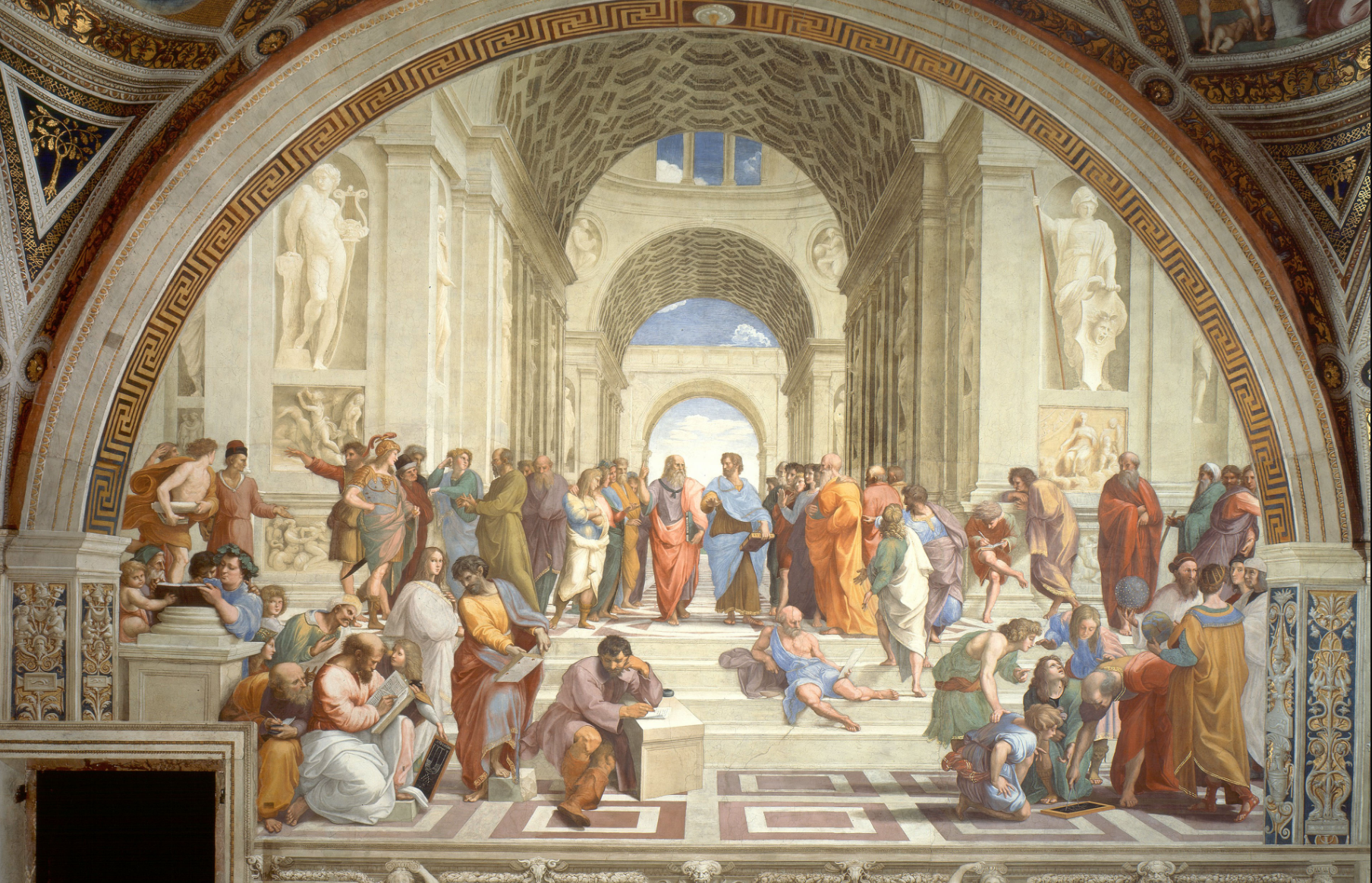
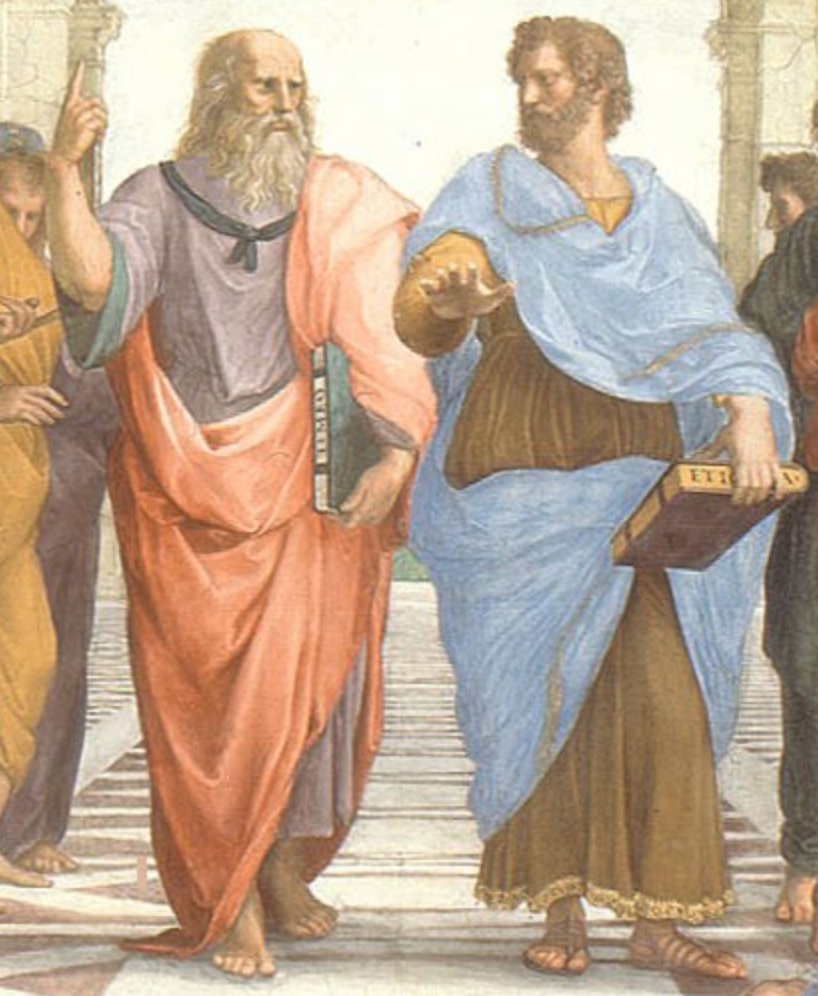
From the outset, I chose to use Raphael’s masterpiece, School of Athens (1509–1511), as the foundational framework to build upon. The original is a Renaissance fresco symbolizing the marriage of art, philosophy, and science by depicting the greatest thinkers of classical antiquity gathered together. It embodies the hermetic principle of "as above, so below" through its central figures, Plato and Aristotle, who represent the synthesis of heavenly, abstract truth with earthly, empirical reality. Plato points up to the ideal forms, while Aristotle gestures down to the physical world, symbolizing the harmony of intellectual, philosophical, and scientific pursuits.
Using this specific framework was commissioned and discussed with a client. We agreed that the collective unconscious is likely ripe and ready to receive high-effort, deeply symbolic pieces of art that prioritize the accuracy of perspective and human anatomy. Leonardo da Vinci (essentially the catalyst of the Renaissance movement) viewed perfection not as an attainable endpoint, but as a continuous, obsessive pursuit driven by relentless observation and meticulous detail. He famously remarked that "Details make perfection, and perfection is not a detail."
Da Vinci, Michelangelo, and Raphael are the three pillars of the Renaissance. All three are inscribed in the original School of Athens fresco; Leonardo da Vinci is portrayed as the central figure of Plato, the elderly, wise philosopher pointing upward to the heavens.
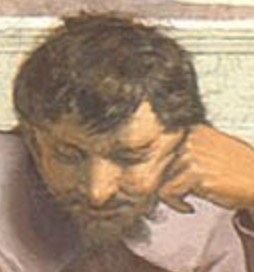
Michelangelo is referenced through the portrait of the philosopher Heraclitus, a brooding, isolated figure in the foreground sitting on a marble block.
The block juxtaposes every other architectural perspective line in the piece. Added last-minute, this figure features Michelangelo’s facial features and wears sculptor’s boots, acting as a tribute to his rival's genius. (Michelangelo was painting the Sistine Chapel in the Vatican at the same time in a nearby building).
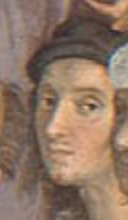
Raphael also referenced his own face, perhaps one of the first times an artist deliberately asserted himself as an intellectual equal to the philosophers, scientists, and poets he depicted.
There are many figures of ancient philosophy and science engaging in dynamic conversation with each other in the original composition—very notably Diogenes, sprawled and cutting across the floor, center-frame. These complex, archetypal human legends dynamically interfacing with each other create an extremely powerful composition.
My project was extremely ambitious. I had to portray my personal snapshot and perspective of modern dynamics at an extremely detailed level of accuracy, taking into account architecture, perspective, layering of materials, anatomical accuracy, and so much more.
Two things happened upon beginning. First, I quickly decided that I was going to stick very close to my reference. To try to one-up Raphael’s compositions and poses is a fool's errand; it's literally a perfect framework to build off of. Secondly, I realized that not all of the characters were going to reference real people who lived. Some of them—in fact, most—were going to be just human figures surrounded by a cloud of representational, abstract symbolism.
What does this mean? One of the characters—Euclid in the original—is seen reaching into a technological void. Wires and foliage crawl up his arm and blast out of the back of his head like a cloudy, abstract firework, representing the juxtaposition of technology and nature punishing the type of man who digs too deeply into that void. My choice of mediums (acrylic, Posca, pen, and basically everything else that dries easily) is what allowed for this level of detail.
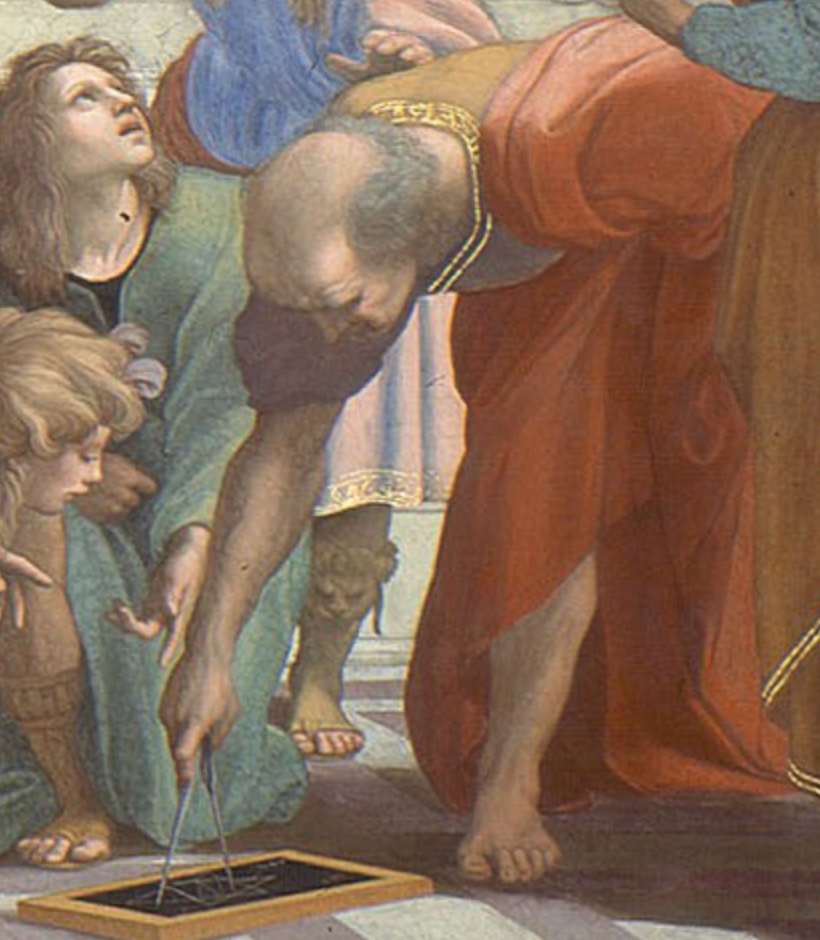
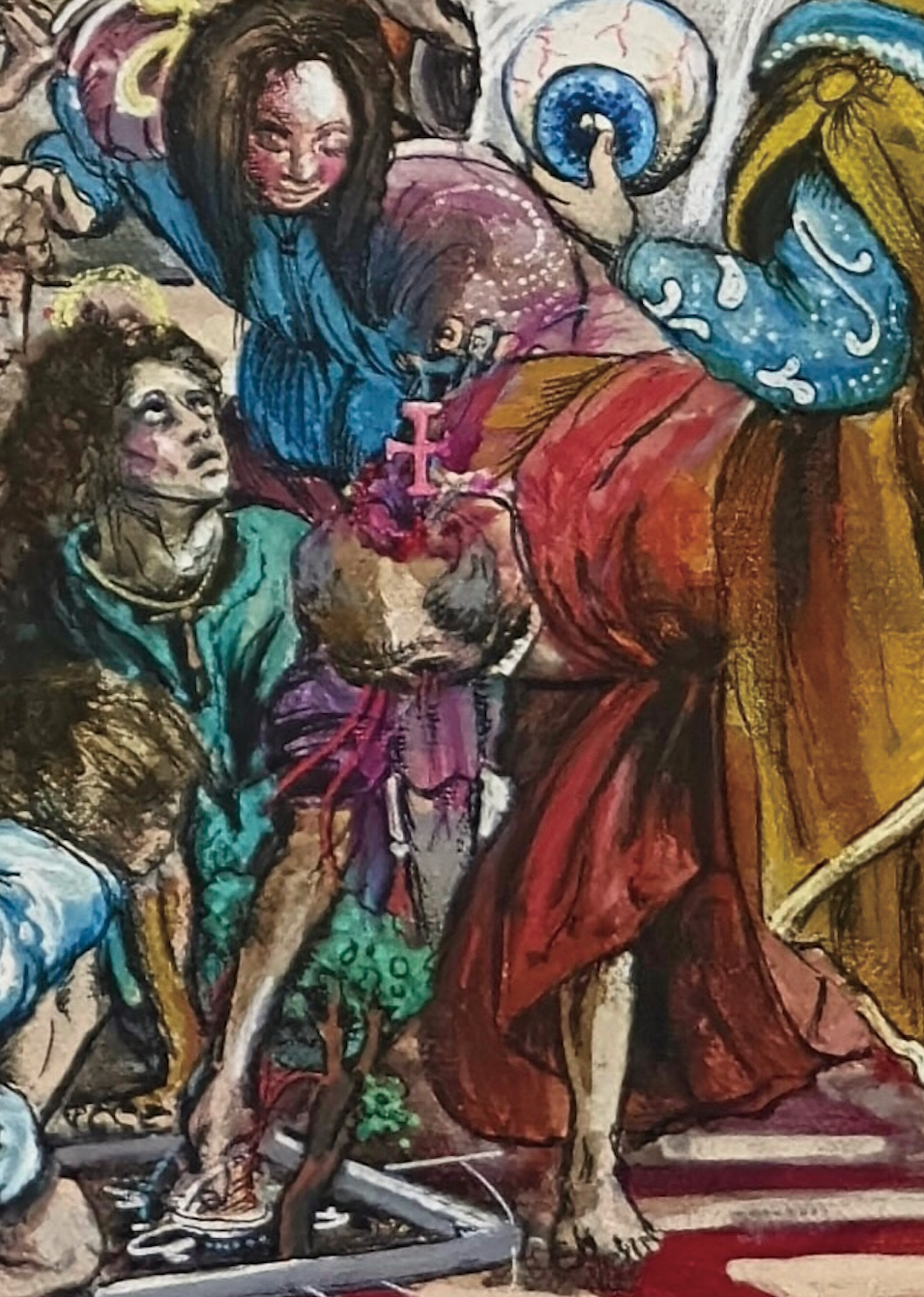
Most of the figures exist in this state of symbolic superposition, representing archetypes not through their literal identity but through symbols, as if one of Carl Jung's dreams sprang to life and plastered itself onto a 2D plane through my hand.
A few of my characters are direct references to living people: myself, to the right, with a sun over my head and devious eyes; and artist Cody Tarantino in place of Michelangelo, his visual language too important for me not to pay homage to with a clock and koi fish.
In place of Diogenes in the blue robes is a man who I frequently run into in Greenwich Village. He has meditated in front of my art a few times and speaks of Christ Consciousness. He calls himself Humble Tiger. Our few brief interactions have informed my approach to life and art greatly; there’s a messianic energy to this man for sure. Several of the figures gesture towards him.
In the center, in place of Plato and Aristotle, stand basically Adam and Eve: archetypal representations of modern man and woman. Man is composed of three chakras: the crown (an eye), the heart (a flower), and the root (a leaf). Modern man is shackled by his karma but is pure reactive energy. Woman, on the other hand, is burdened with pointing both above and below, the responsibility of tending to both the heavens and the material plane falling heavily on one gender. She gazes at the messianic figure beneath her.
Every perspective line leads to a red apple in the hand of the archetypal man. This object represents something close to the fruit of the tree of good and evil.
All of this is witnessed by the sun and the moon in the top corners. The sun anchors the masculine side, representing active consciousness, illumination, and raw generative energy. The moon represents the feminine, embodying intuition, the deep unconscious, and the cyclical nature of time. Yet, just as in life and alchemy, there is much representational overlap between the two—each relies on the other to bring balance to the composition.
This was a profoundly demanding piece to produce. It dominated my headspace for at least a month, and I became a bit obsessive. I believe it will be important in some capacity—either as an emergence in a Renaissance rebirth, or to be unearthed later as a relic of a rather complicated time in human history, where symbols fuse with reality through the hive-minded mechanism of the internet. It represents a time where the highest stakes are placed on the shoulders of regular men and women; a space where people dynamically interact—pointing fingers to accuse, reaching out to comfort, or gesturing to debate—hurling bits of information back and forth under the eternal witness of our two astrological bodies, the sun and the moon.